
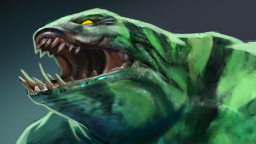
Tidehunter
Tidehunter Dota 2 is a strength melee offlaner whose job is to survive the first twelve minutes and then start the fight — a Ravage that stuns everything within 1,250 units. He won 48.48% of 1,382 pro games (97.97% offlane). His damage is not the point: Kraken Shell blocks 15/35/55/75 per physical hit and self-dispels after 600/550/500/450 damage within 7 seconds — so walk in, eat the first round, then Ravage.
He is a position-3 front line, not a damage core. 97.97% of his 1,382 pro games are offlane — 1,354 of them — where he wins 48.74%. His value is Ravage, Kraken Shell's block and dispel, and Anchor Smash's attack-damage reduction.
7.41f has no Tidehunter entry, but it is not empty for his build. The last hero change is 7.41c (0.5 mana regen); 7.41f cut  Shiva's Guard's Arctic Blast from 260 to 225 and raised Octarine Core from 4,900 to 5,100. The Phase Boots, Soul Ring and Vladmir at 12.6 opener is unchanged.
Fight through your body, not through your damage. Walk in first, let the 600/550/500/450 dispel clear the opening disable, then Ravage from where you stand — the wave reaches the back line on its own. Keep Anchor Smash on a 4-second cooldown while it travels.
Is Tidehunter still viable in Dota 2 7.41f?
Yes — as a position 3, and the numbers agree on how much. Across the 7.41 window he won 48.48% of 1,382 pro games; across a rolling week of public matches he won 49.20% of 462,208. Two different crowds, same answer: he is a coin flip, not a pick that wins by being picked.
He gets worse as the bracket gets better. The public curve runs from 50.66% in Herald down to 47.71% in Divine, a 2.95-point slide across seven brackets, with one wobble in the middle: Guardian (49.96%) sits below Crusader (50.16%). The curve ends at Divine.
Pro teams pick him on purpose and still only break even. The window holds 8,972 league games; he is picked in 15.21% of them and banned in 13.95%, and he appears in 2,617 drafts — 29.17% of all of them. Picks outnumber bans, which is the shape of a hero teams are comfortable taking rather than one they are afraid to face.
7.41f has no Tidehunter entry, but it is not empty for his build. The last hero change is 7.41c, which cut base mana regen by 0.5; 7.41f also touched two items he buys — Shiva's Guard and Octarine Core — the numbers are in the patch section below. The structural work was 7.41: strength gain went from 3.6 to 3.7, Blubber was replaced by Leviathan's Catch, Kraken Shell gained a strong dispel, and Anchor Smash's radius was rewritten as attack range plus 225. None of it is a damage swing; all of it changes how the first ten minutes are played.
He is a timing hero: the numbers peak around the half hour. His win rate climbs to 50.42% in games ending at 30 minutes (4,738 games), then slides to 47.55% at 55 minutes (572), with a bump back up at 60 (53.72% over 296). All of this comes from 23,598 games with duration data — about 5.11% of his 462,208 public games — so read it as a direction. The build is aimed at that peak: Vladmir at 12.6 and Blink at 21.1 get one fight-winning Ravage out before the enemy lineup itemises around it.
Which position should Tidehunter play?
The pro answer is not close: 97.97% of his 1,382 pro games are offlane — 1,354 of them, at a 48.74% win rate. The other lanes exist but not in any useful quantity: the safe lane and mid together are 23 games, 1.66% of his games. There is no second position to compare against, and in pro drafts Tidehunter is a fixed assignment rather than a flex pick.
His income is front-line money, not win-condition money. His pro line: 527 GPM, 700 XPM, 266.2 last hits, level 20.6 by the end. That buys a 2,200-gold first item at 12.3 minutes (the first-major median) and nothing more — and a hero with no escape and no ranged wave clear cannot be given the safe lane. You would be spending a farm priority on a body whose job is to stand in front, not behind.
The kit is built to tax the enemy carry, and the enemy carry lives in the safe lane. Kraken Shell blocks 15/35/55/75 of every physical hit; Anchor Smash hits everything within attack range plus 225 for 50/100/150/200 bonus damage and cuts the attack damage of everything it hits by 25/30/35/40% for 6 seconds; Gush takes 3/4/5/6 armor off one target for 4.5 seconds and slows it by 40%. Point that at the enemy safe lane and every last hit and every trade is smaller. Play him in your own safe lane and you have spent the lane's farm on a hero who cannot convert it.
He needs levels more than he needs gold, and the offlane is where the levels come from. 78.37% of pro games take Ravage at the sixth skill entry, and Kraken Shell's dispel threshold falls from 600 to 450 as it levels. A position 3 shares a lane, gets solo experience when the support rotates, and reaches the level-6 Ravage on time — which is the first moment the hero does something a carry cannot.
The hero's own tags still list carry, and that label describes his stat growth rather than the lane players put him in. Pro games answer it directly: 97.97% offlane, 48.74% in it. These lane numbers are pro-only; public matches have no lane split, so nothing here argues for the safe lane.
How did his win rate move by patch?
What actually changed for Tidehunter in 7.41?
7.41f has no Tidehunter entry, but the series did not stop at 7.41c. The last hero change is 7.41c (base mana regen 0.5 lower); 7.41d cut Mage Slayer's damage from +15 to +12, 7.41e cut Shiva's Guard's recipe by 100 gold, and 7.41f cut Shiva's Guard's Arctic Blast from 260 to 225 and raised Octarine Core's total cost from 4,900 to 5,100. The chart above shows only the four sub-patches with at least a hundred pro games; 7.41, 7.41e and 7.41f are below that, so they are not shown. The spread on those four bars — 45.52% to 52.35% — is within the noise of 149-to-536-game groups, so read it as one hero measured four times, not four different heroes, and keep the build and the plan unchanged.
7.41 swapped his innate. Blubber is gone, and Leviathan's Catch took its place: an enemy hero who dies while carrying any Tidehunter debuff, or who is killed by him, drops a fish. Eating one gives 3 max HP, 2 attack range and 1 damage block permanently; a free fish is eaten automatically at every even level. The catch is that the block only applies while something else is already blocking damage, so the fish multiply Kraken Shell rather than replacing it.
Kraken Shell gained a strong dispel, and that is the biggest change in the patch. Take more than 600/550/500/450 damage inside 7 seconds and Tidehunter dispels himself. It is a strong dispel, so stuns, roots, silences and slows all come off. The old level-20 talent that made Blubber trigger Anchor Smash was rewritten to trigger it off this cleanse, so the dispel can also become a 50%-damage swing.
Anchor Smash's radius was re-expressed, not changed. It used to be a flat 375; now it is attack range plus 225, which is the same number on his 150 base range. The difference is that anything raising his attack range now raises the radius, and the fish do exactly that at 2 units each. At level 18 the level-ups alone have handed him 9 fish: 18 attack range, and a radius of 393.
The follow-up patches trimmed the edges. 7.41a cut the fish's launch distance from 400 to 200. 7.41b cut base strength from 26 to 25 and level-1 damage from 51–57 to 50–56, moved fish from every level to even levels only, took the level-15 Gush talent from 100 to 90 extra damage, and made the level-25 building talent deal 50% damage to buildings. 7.41c took the 0.5 mana regen. None of it changes the plan; all of it makes the first ten minutes slightly tighter than they were at 7.41.
What is Tidehunter's skill build?
Max Anchor Smash first, then Kraken Shell, and leave Gush for last. Anchor Smash gets its point at the fifth entry in 89.49% of pro games and is finished at the seventh in 85.53%; Kraken Shell starts at the eighth (58.0%) and continues at the ninth (62.86%). Gush is a value point early — 46.24% take it first — and is maxed last: 78.19% at the twelfth, 73.45% at the fourteenth, 62.28% at the fifteenth.
Level one is close to a coin flip between the two lane tools. 52.39% of pro games open with Anchor Smash and 46.24% with Gush. Anchor Smash is the trading button — 50 bonus damage and a 25% attack-damage cut at rank one — while Gush is the 700-range slow that sets up a kill. Take Anchor Smash into a lane you have to survive, Gush into a lane where your support can convert the slow.
The most common ten-point sequence is a template, not the rule. 129 pro games (9.5% of the 1,359 that recorded a tenth skill entry) take Gush, then Anchor Smash twice, Kraken Shell, Anchor Smash, Ravage, Anchor Smash, then Kraken Shell three times. That maxes Anchor Smash at the seventh entry and Kraken Shell at the tenth, with Ravage at the sixth.
The level-10 talent usually lands one entry late. 64.61% of pro games take it at the eleventh entry, which means most pro players finish a basic before spending the talent. The bar below opens with Anchor Smash instead: talent at 10, Gush at 9, Kraken Shell's last point at 11. That gives up one level of block and dispel threshold, and the max order is what matters.
 1
 2345
 678
 910111213141516182025
What items should Tidehunter buy?
A practical Tidehunter Dota 2 build starts with the two cheap items that fix his two problems. 97.76% of pro games buy  Phase Boots at a 7.8-minute median and 86.4% buy
 Soul Ring at 8.4. Phase Boots give him the armor and the move speed to walk in and back out; Soul Ring covers a hero whose Ravage costs 125/225/325 mana on a kit that also spends 100 on every Gush — and 7.41c cut his base mana regen by 0.5, which is why a Soul Ring is standard.
The first real item is Vladmir, and in pro games it lands eight and a half minutes before Blink. Vladmir is the first tracked major item in 43.1% of tracked first-major games and is bought in 45.8% of all games at a 12.6-minute purchase median;  Blink Dagger is bought in 79.45% of games, nearly four in five, at a 21.1-minute purchase median. Compare the minutes, not the shares: the 43.1% is a first-item share, not a time. The items cost almost the same, 2,200 against 2,250, so this is not a price decision: it is a decision about what the first twelve minutes need.
The reason is that Ravage does not need Blink to start a fight. It is a 1,250-radius stun with a 0.3-second cast point, and the first thing it needs is a Tidehunter who is alive and standing in the enemy team.  Vladmir's Offering buys that: a team aura on the hero who is supposed to take the first round of right-clicks. Blink buys the angle — it puts Ravage on a specific back-line target — and angles are worth paying for at 21 minutes, not at 12.
The three initiation items arrive close together, but each is its own purchase. Blink at 21.1,  Aghanim's Scepter at 22.5 and
 Aghanim's Shard at 23.1 are three separate purchases, not a fixed order; each is common on its own: Scepter 57.16%, Shard 72.36%, Blink 79.45%. Scepter turns Gush into a ground-targeted wave that hits in a line and lowers its cooldown; the Shard adds Dead in the Water, a 350-range leash that drags a hero at 100 move speed for 10 seconds and takes 4 hero attacks to break. With Ravage, that is three separate tools for keeping a fight where you want it.
After that the build is answers, not a shopping list. Shiva's Guard is the most common of the later items at 26.99% (30.4-minute median);  Pipe of Insight appears in 9.99% at 20.1;
 Black King Bar in 13.02% at 35.6;
 Refresher Orb in 12.59% at 42.5 for a second Ravage;
 Scythe of Vyse in 10.13% at 38.1 for a hard disable that does not depend on Ravage. Be careful with the win rates on this list — Shiva's 61.93% and Aghanim's Scepter's 54.81% are what winning teams can afford, not proof that the item wins games.
Do not buy damage. Desolator is a 2.17% purchase (30 games, 17.0-minute median), Radiance 1.37%, Echo Sabre 1.52%, Harpoon 1.45% — all of them rare, and none of them what the hero is for. The one damage-adjacent item pros actually buy is  Mage Slayer at 22.36%, and it is bought as the anti-caster item, not as damage.
Default build:Starting items  Tango
 Circlet
 Iron Branch
 Gauntlets of Strength→Lane: mana and a cheap stat block
 Magic Stick
 Bracer
 Boots of Speed→First upgrade: the armor and move speed to walk in Phase Boots→Mana for Ravage and Gush Soul Ring→First major item: Vladmir by default, Mage Slayer against magic, Consecrated Wraps when the lane is lost Vladmir's OfferingMage Slayer
 Consecrated Wraps→The initiation angle Blink Dagger→Second and third lock: the leash and the wave Aghanim's ShardAghanim's Scepter→Late answers Shiva's GuardPipe of InsightBlack King BarRefresher OrbScythe of Vyse
 Lotus Orb
Which talents should you take?
Level 10 is the Gush slow, and it is not close. 83.41% of level-10 talent picks are +20% Gush Slow (1,031 games, 48.79% win rate) over +10% Anchor Smash damage reduction (205 games, 42.44%). Gush already slows by 40% for 4.5 seconds; the talent makes the slow the reason to cast the spell rather than a bonus on top of the armor reduction. The lower win rate on the Anchor Smash talent is not a verdict — it is only 205 games, and a team that is behind is more likely to spend its talent on defence.
Level 15 is Gush damage. 77.9% of level-15 talent picks take +90 Gush Damage (913 games, 51.92%) over −15s Ravage Cooldown (259 games, 45.17%). The cooldown talent is the one that looks like a teamfight talent, and pro players reject it: cutting a 150/145/140-second cooldown by 15 does not give you a second Ravage in a fight, it only makes the next fight come sooner. Gush damage sits on a 12-second cooldown and is cast 39 times a game at the pro median.
Level 20 is the Gush armor talent in most games, but the more interesting pick is the other one. 75.0% of level-20 talent picks take −4 Gush Armor (576 games, 57.99%); 25.0% take Kraken Shell Cleanse triggers Anchor Smash (192 games, 61.98%). On the numbers the minority pick wins more, and on 192 games that is not something to act on. What is worth knowing is what it does: it converts the dispel into an Anchor Smash at 50% damage, dealt as reflected damage that cannot lifesteal and cannot be reflected again — the worst case for an enemy who chain-stuns you.
Level 25 is +1 second of Ravage stun in most games. 89.23% of level-25 talent picks take it; the Anchor Smash buildings talent is taken so rarely that there are too few games to call it. One second on a 2/2.2/2.4-second stun is a real change, but the talent arrives at level 25, when the game is usually already decided. Take the stun and do not build around it.
How do you counter Tidehunter?
The counter is to make Ravage a bad trade, and the public table says nobody does it cheaply. His worst public matchup is Ember Spirit at 39.53% over 258 games, then Snapfire at 39.73% (219), Slardar at 43.95% (223), Hoodwink at 44.93% (227) and Tusk at 45.49% (255). The best is Mars at 53.85% (234). The whole spread is 14.32 points, which is another way of saying that no single pick turns him off — you beat him with a draft that can avoid a 1,250-radius stun.
The bad matchups split in two. Snapfire and Hoodwink play from outside Anchor Smash's 375-unit radius, where his only answer is a 700-range Gush; Ember Spirit is melee and mobile enough to leave before the swing; Slardar and Tusk go the other way and beat him at contact. Slardar's armor reduction makes every physical hit bigger, which is the damage Kraken Shell has to absorb.
Pro games point at different heroes. Lone Druid and Clockwerk are his worst pro matchups, but on 42 and 64 games — direction only — too few games to quote a rate. Slark and Drow Ranger are down there too, on 82 and 47 games. With a hundred games or more, the worst are Slardar at 40.54% (111), Snapfire at 40.78% (103) and Tusk at 42.86% (133); the best is Spirit Breaker at 66.36% (107). Ember Spirit is the bottom of the public table at 39.53% (258) but 42.96% (142) in pro games — two sources, two answers, and neither one settles the matchup on its own.
How to actually counter him. Kraken Shell only blocks physical attack damage, so magic is the way through the hide — but every point of damage also counts toward the 600/550/500/450 dispel threshold, so kill him inside one window instead of chipping him down. Spread out so the 1,250 radius cannot catch three heroes, and force the Ravage out before the fight: it is on a 150/145/140-second cooldown and he only gets about 6 casts a game in pro play. And do not plan a fight around one long disable — that is the exact thing the strong dispel is there to undo.
Lowest win rates against these heroes
 Ember Spirit39.53% · n=258
 Snapfire39.73% · n=219
 Slardar43.95% · n=223
 Hoodwink44.93% · n=227
 Tusk45.49% · n=255
 Shadow Fiend46.94% · n=294
 Centaur Warrunner47.34% · n=207
 Rubick48.33% · n=360
Highest win rates against these heroes
 Mars53.85% · n=234
 Lion52.49% · n=221
 Jakiro51.56% · n=289
 Queen of Pain51.46% · n=206
 Disruptor50.89% · n=224
 Warlock50.24% · n=209
 Ursa49.78% · n=223
 Windranger49.76% · n=205
Public matches, rolling window (captured 2026-11-07). Only opponents with 200 games or more are shown, and each number is Tidehunter's win rate when that hero is on the enemy team, with the game count on its row. These figures include each opponent's overall strength and are a drafting reference, not the result of an isolated duel. The pro figures quoted in this section are the same measure — Tidehunter's win rate with that hero on the enemy team — taken from a separate set of pro games, and they are not comparable row for row with these.
How should you play the laning stage?
Level one is Anchor Smash or Gush, and both are lane tools. 52.39% of pro games open with Anchor Smash: 50 bonus damage on the swing, and everything hit loses 25% of its attack damage for 6 seconds at rank one, which is what makes a two-versus-one lane survivable. The 46.24% who open with Gush get 100 damage, 3 armor off and a 40% slow for 4.5 seconds at 700 range — the better opener when your support can follow the slow.
Kraken Shell is the reason he can stand in a lane he does not win. Rank one blocks 15 per physical hit, and the block is per hit, so two heroes right-clicking you is exactly the case it is built for. The dispel threshold is 600 at rank one and falls to 450 at rank four; crossing it inside 7 seconds removes slows, roots and stuns, which is a get-out button in the first five minutes.
The fish are a lane mechanic before they are a late-game one. Every enemy hero who dies with a Tidehunter debuff on them drops one worth 3 max HP, 2 attack range and 1 damage block. A free fish is eaten automatically at every even level, so by level 18 the level-ups alone have given you 9 fish — 18 attack range, and therefore 18 units of Anchor Smash radius, so the lane's trading tool quietly gets bigger every two levels.
Fish can be destroyed, and that matters in a long lane. A fish flies 200 units toward Tidehunter when it spawns, and any enemy can kill it with one attack. If you are losing the lane, the fish from your kills are most of what you keep; if you are winning it, do not let the enemy support farm them.
Mana is the lane's real limit. Gush costs 100, Anchor Smash 40/45/50/55, Ravage 125/225/325. With a base mana regen that 7.41c cut by 0.5, the pro answer is a Soul Ring at 8.4 minutes in 86.4% of games. Buy it before the first fight, not after the first death.
How should you play teamfights?
Ravage is not an instant 1,250-radius stun; it is a wave. The tentacles travel outward at 725 units a second, so a hero at the edge is hit about 1.7 seconds after the 0.3-second cast point and a hero standing next to you is hit immediately. That is why the cast belongs on the front line rather than on the back-line carry: the wave reaches the back line on its own, and the front line cannot walk out of it. Blink is the exception — with it, jumping their back line and Ravaging there is what the 21.1-minute purchase is for.
Walk in first and let Kraken Shell eat the opening round. 15/35/55/75 block per physical hit, doubled for 4 seconds by the active at a cost of 40% move speed, plus a strong dispel at 600/550/500/450 damage inside 7 seconds. The dispel is the real reason he can be the first body in: the opening combo is usually what crosses the threshold, and once it fires you are free to cast.
Anchor Smash is the button you never stop pressing. At max rank it is a 4-second cooldown for 55 mana, hitting everything within attack range plus 225 for 200 bonus damage and cutting 40% of the attack damage of everything it touches for 6 seconds. Against a physical lineup that is damage reduction on a four-second timer for everything near you; against creeps it is how you take a wave.
Gush is the setup, and the Scepter turns it into a line. 100/160/220/280 damage, 3/4/5/6 armor off and a 40% slow for 4.5 seconds, on a 12-second cooldown at 700 range. With Aghanim's Scepter (57.16% of pro games at 22.5 minutes) it becomes a ground-targeted wave that hits everything in a line and comes back faster — a second area spell to open with, before Ravage.
The Shard is the third tool, and the one that handles a single slippery core. Dead in the Water attaches an anchor at 350 range: the target is leashed to 350 units, dragged at 100 move speed past that, held for 10 seconds, and freed by 4 hero attacks. On a 35-second cooldown it is the answer to a hero who can dodge Ravage — leash first, Ravage second.
Do not lead with Ravage from max range into a mobile draft. The wave's travel time is the window a mobile hero uses to step out. Cast it where they have to stand, or wait for their gap closer to be spent and then Ravage the hero who landed.
What don't the ability descriptions tell you?

Which mistakes should you avoid?
Are any off-meta builds worth considering?
In pro games there is no second position to speak of. The safe lane and mid together are 23 of 1,382 games — 1.66% — so nothing in this data supports a carry build. The kit agrees: no escape, no ranged wave clear until Aghanim's Scepter, and a first item that is an aura.
The one real off-meta opener is Aghanim's Scepter first. 10.79% of pro games make it the first major item at a 17.8-minute median, against a 22.5-minute median for Scepter purchases overall. It is a legitimate response to a game where the lane is free and the fights are about area control: the wave turns Gush into a second area spell on a shorter cooldown.
Refresher is the late-game version of the same idea. 12.59% of pro games buy it at a 42.5-minute median, and a second Ravage is the only purchase that gives the hero his ultimate twice. It is a 42-minute item because that is when the gold exists and the fights are long enough to want two casts.
Damage builds exist and are small. Desolator shows up in 2.17% of pro games (30 games, 17.0-minute median), Radiance 1.37%, Echo Sabre 1.52%, Harpoon 1.45%, Octarine Core 3.4% at 36.1. Octarine's 72.34% win rate on 47 games is the kind of number that looks like a discovery and is not one: a luxury item bought by teams that were already winning.
Queue offlane. In pro games 97.97% of his 1,382 appearances are there, and the 527 GPM line is a position-3 income, not a carry's. Have Phase Boots by 7.8 minutes and Soul Ring by 8.4. Ravage costs 125/225/325 mana, and 7.41c cut his regen by 0.5. Buy Vladmir before Blink — 12.6 minutes against 21.1. Ravage already covers 1,250 units around you, and Vladmir is what keeps you alive on the walk in. Treat Kraken Shell's dispel as your defensive button. 600/550/500/450 damage inside 7 seconds clears the stun, so one long chain-stun is not the end of you. DOTA Timer tracks Bounty Runes, Wisdom Runes, Lotuses, Tormentors and Roshan so you can spend your attention on the Ravage angle instead.