
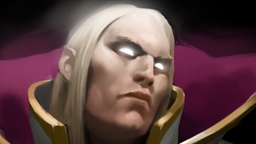
Invoker
Invoker is the Dota 2 intelligence hero who builds his own spellbook: he keeps three orbs up, combines them into ten possible spells, and can hold only two at a time. His 7.41f public win rate is 50.31% over 3,751,746 ranked games, and the pro sample sits at 51.71% over 1,052 league games — a 1.40-point gap, smaller than the roughly ±3.0 points of noise in that pro sample, so both samples are effectively even. Patch 7.41f gave him nothing: it raised Cold Snap's cooldown and cut the Ghost Walk Shard's damage to creeps.
Playable, but only average right now—and best played mid. His spellbook can supply control, burst or global support; the cost is preparation. The two spell slots must be loaded before the fight, and support gives him less time and fewer resources to make that versatility matter.
This patch did not buff him; it only lightly nerfed Cold Snap and the Ghost Walk Shard. Level Exort first, Quas second and Wex later. Build Kaya into Meteor Hammer, then Boots of Travel and the Shard; the Scepter is the situational piece. Aghanim's Scepter is not automatic: buy it only when you already know which branch you will use.
Do not enter a fight trying to use all ten spells; decide which two the next fight needs. Sun Strike pierces debuff immunity, but its damage splits across every enemy in the radius, so aim at an isolated target rather than a creep wave.
Is Invoker still viable in Dota 2 7.41f?
Yes, and the honest number is "barely above even". This Invoker Dota 2 guide starts with the sample that actually exists: a 50.31% public win rate across 3,751,746 ranked games in 7.41f, with a 17.87% pick rate and an all-hero tier rank of 49 of 127 in Batru's public dataset. The pro sample gives 51.71% over 1,052 league games, which is roughly ±3.0 points of noise at that size. He is picked in 11.75% of pro drafts, banned in 17.34%, and appears in 29.10% of them counting both — a normal rotation hero, not a first-phase priority.
The shape of the public curve is the part worth knowing. OpenDota's seven-bracket public sample — a rolling seven-day window rather than a patch slice — runs from 49.85% in Herald to 51.59% in Divine, 1.74 points of total movement, and no bracket falls below 49.85%. Batru's four patch-tagged bands tell the same story: 50.10% in Herald and Guardian up to 51.58% in Divine and Immortal, where his tier rank improves from 49 to 35. He is a little better where the opposition is better, and the size of that "little" is the whole story.
The reason to play him is not a patch number; it is that the hero is two heroes. In public games that record a role, 69.8% of Invokers go mid and 27.8% play support, and those two groups earn 536 and 380 gold per minute — the mid earns about 40% more on the same kit. In pro, 94.0% of games are mid and the support branch effectively does not exist. So a 10-minute Kaya and a 10.8-minute Meteor Hammer describe one job, not the hero.
What follows from that is a rule for reading this page. Every item rate, skill order and talent rate below comes from pro mid games unless it says otherwise, and the public position and matchup numbers are labelled public. Where the two samples disagree — Shadow Fiend, most obviously — they are reported separately and not averaged, because a 58.06% matchup over 248,121 public games and a 41.56% matchup over 154 pro games are measuring two different jobs.
Which position should you play Invoker in Dota 2?
Mid is the only position where he clears 50% in public games. dotacoach's role table covers 322,717 games — the slice of the 3,751,746-game public sample where a role is recorded, not the whole sample. In it, mid is 69.8% (about 225,000 games) at 51.6% and 536 GPM; offlane is 1.4% at 47.1%, carry 1.0% at 48.4%, support 17.7% at 48.2% and hard support 10.1% at 48.5%. Leaving mid costs between 3.1 and 4.5 points of win rate, and the two support roles also cost about 155 gold per minute.
Pro is more extreme: 94.0% of 1,052 games are mid. Those 989 games run 51.57% with 588 GPM, 275.9 last hits and an average finishing level of 21.1. Offlane is 4.4% (46 games) and safe lane 1.0% (11 games): the safe-lane bucket is under the 30-game floor, and neither role is a plan.
The support share is a real number, not a joke number. 89,742 public games are played as one of the two support roles, winning 48.2%–48.5%. That is a 3.4-point drop from mid and a 155-gold-per-minute gap, and it exists because the cheap half of the kit — orb passives, Alacrity on a carry, Cold Snap, Ice Wall, EMP — does something at low orb levels. The expensive half does not: Invoke's cooldown is set by orb levels, so a support Invoker is a slower Invoker.
Do not play him as a carry. 1.0% of public games, 48.4% win rate, 528 GPM. His damage is gated by orb levels and spell casts, not by attack speed, and a carry's job — hitting buildings — is the one thing his kit barely does. If you want a ranged intelligence core in the safe lane, this is not the hero.
What changed in 7.41, and did 7.41f help him?
7.41f is two nerfs and no buff. Cold Snap's cooldown went from 18 to 19 seconds, and the Ghost Walk Shard stopped dealing its damage to non-hero units. That is the entire Invoker section of the patch, and it is why his last change is logged as 7.41f. The public win rate moved from 50.37% to 50.31% across the patch — 0.1 of a point in a 3,751,746-game sample, which is visible in the data and irrelevant in a game.
The break in his patch history is 7.41b, not 7.41f. 7.41b gave him an extra ability point at hero levels 6, 12 and 18 that can only go into an orb. On the public curve 7.41a sits at 46.53% and 7.41b at 51.74%; on the pro curve 42.62% to 47.79%. Two independent pipelines, the same 5.2-point step, in the same window — and neither source attributes the step to the patch, so neither does this page. It is a coincidence worth knowing, not a proven cause.
Only 97 pro games were played on 7.41f itself at the time of writing. That is a direction, not a rate: the pro patch-by-patch curve is read as a pointer only. Everywhere else on this page the floor is 30 pro games — under that, no pro number is quoted as a rate at all. The public curve has 3,751,746 games behind it and is the one quoted above.
7.41 rewrote what his gold buys, and that is the change that still shapes builds. The orb cap went from 7 to 8, so filling every orb now costs 24 points instead of 21. Aghanim's Scepter and Shard now arrive inert: you activate them, choose one of three upgrades, and the choice is permanent — selling and rebuying returns the same one. The Scepter raises exactly one chosen orb to level 9; the other two stay at 8. 7.41 also deleted the facet system across the roster, so he has no facet and his real fork is orb allocation.
What is Invoker's Dota 2 skill build?
Exort first, Quas second, and a single Wex point at the sixth or seventh slot. In the pro sample the first point is Exort 93.5% of the time, the second is Quas 93.9%, the third is Exort 83.4%, the fourth is Quas 78.0% and the fifth is Exort 82.2%. The single most common opening ten is E-Q-E-Q-E-Q-W-E-Q-E, at 301 of 1,043 games — 28.9% — and the second most common differs only by swapping the sixth and seventh slot.
Talk about points, not hero levels. Because of the 7.41b bonus point, a level-6 Invoker already holds two fresh points: the sixth and seventh slots both land at level 6, and the tenth point is taken at level 9. Only the first five slots map one-to-one onto levels 1–5. The one safe level anchor is the talent, because a talent cannot be taken early: pro takes the level-10 talent at hero level 11 and the level-15 talent at 17.
Exort is the line that gets finished, and Wex is the tax you pay late. In games where any orb reaches level 8, it is Exort 93.3% of the time. At hero level 17 the shape is Exort 8, Quas 4, Wex 5 — 17 orb points, which is seventeen levels plus the two bonus orb points from levels 6 and 12, minus the two points spent on talents — and by the eighteenth point, 82.0% have Exort at 8, 67.9% have Quas at 4 and 55.3% have Wex at 5. Exort is the one orb maxed there; Quas and Wex are not, and the remaining orb points go into them after level 17. Wex's first point usually goes in at slot 6 or 7, to build toward Tornado (Q-W-W) and Alacrity (W-W-E) — with a single Wex point neither is castable yet, and EMP needs three Wex. The seventh slot is the first slot where Wex is the most-picked orb at 40.0%, and by the eleventh slot it is the modal pick at 42.7% — a per-slot count, not a claim about which orb ends up highest.
There is a Quas–Wex build, and this is not it. The pro sample is a Quas–Exort sample: Wex can be the most-picked orb at a slot, but it is never the highest-level orb overall, and EMP is cast a median of 5 times a game, with 10.6% of games never casting it at all. If you are playing him as a support or a roamer, the QW route is the one that fits — but it is a public-game route with no pro item or skill data behind it, so do not read the order above into it.
 1
 23456
 6789101112121314151617
What items should Invoker buy in Dota 2?
A practical Invoker Dota 2 build puts Kaya in your inventory inside the first ten minutes. 70.7% of pro games (744 of 1,052) complete Kaya first, at a median of 10.0 minutes, and the middle half of those purchases fits inside 8.7–11.2 — two and a half minutes of spread. Meteor Hammer follows at 10.8 (71.6%), Boots of Travel at 16.7 (78.8%) and Aghanim's Shard at 22.7 (63.2%). None of those four is a reaction to the game; they are the script.
Aghanim's Scepter is a priced choice, not a core item. 45.3% of pro games buy it, at a median 23.3 minutes, which means more than half of them never do. On activation you pick one of three upgrades and keep it: Ice Floe (Quas +1), the Tornado twisters (Wex +1) or Cataclysm (Exort +1). If you pick one of the first two, double-tapping Sun Strike does nothing special, because Cataclysm lives only on its own branch — and there is no 7.41f data on which branch wins more.
After the four-piece core, items are answers rather than steps. Octarine Core is 42.9% at 27.4 minutes, and it buys health, mana and 25% cooldown reduction — not spell lifesteal, which is Bloodstone's job now. Black King Bar is 36.2% at 25.8, Blink 22.3% at 26.0, Scythe of Vyse 19.1% at 36.8 and Refresher 10.6% at 44.0. Rod of Atos, 30.0% at 16.5 minutes, is the catch item, and it upgrades into Gleipnir — 17.9% of pro games finish it at a 29.3 minute median, 188 games in total. Older tables list Gleipnir under a different internal name and report zero games for it; the purchase log says otherwise.
Do not read the buy-versus-skip win rates as advice. Every late item in this sample correlates with winning because only a game that is already going well reaches 33 minutes with 5,000 gold spare; Linken's Sphere looks like 24.46 points of value purely because it is a 33.9-minute purchase. The two items that show no difference at all are the two tempo items: Kaya at 0.52 of a point and Meteor Hammer at 0.73. They are how the hero functions, not what wins the game. Two smaller traps: Power Treads is 7.3% and is mostly what a game that cannot reach Travels ends up buying, and Hand of Midas at 12.1% and 6.6 minutes marks a decision that the game will be long — not the reason it was lost.
Default build:Opening: two circlets, two branches, a tango and a faerie fire — one documented opening, with a null talisman and magic wand start as the alternative  Tango
 Faerie Fire
 Circlet ×2
 Iron Branch ×2→The ten-minute block: null talisman and magic wand first, then Kaya as the first real item
 Null Talisman
 Magic Wand
 Kaya→Second item at 10.8 minutes: Meteor Hammer, straight after Kaya
 Meteor Hammer→Movement at 16.7 minutes: Travels in 78.8% of pro games, with plain boots often held back until an 8.2-minute median
 Boots of Travel→Mid-game choice at 22.7–23.3 minutes: Shard first (63.2%), Scepter only on the games you will use its branch (45.3%)
 Aghanim's Shard
 Aghanim's Scepter→Cooldown and survivability: Octarine Core for the cooldown, Black King Bar against silence and magic burst
 Octarine Core
 Black King Bar→Situational: Atos into Gleipnir for catch, Blink for initiation, Scythe for single-target lockdown (hex), Refresher for a second rotation
 Rod of Atos
 Gleipnir
 Blink Dagger
 Scythe of Vyse
 Refresher Orb
Which talents should you take?
The level-10 row has a real answer: +50 Ice Wall damage per second. It is taken in 76.8% of pro games (799 of 1,040) and it is also the higher-win-rate side, 53.94% against 46.47% with a z-score of 2.03. That is the edge of significance, so read it as "the majority is not wrong here" rather than as a seven-point talent. It is the only tier where pick rate, win rate and every written guide agree.
The level-15 row has a majority but no measurable edge. −6 seconds of Cold Snap cooldown is taken 74.7% of the time (714 of 956). The alternative, +25 Alacrity attack speed and damage, shows no measurable difference at that sample size (|z| = 1.29). Take Cold Snap because a second Cold Snap in one fight is worth more than a bigger Alacrity, not because of a win-rate difference.
Level 20 and 25 are qualitative, and that is a data limit rather than a judgement. The replay's ability array caps at 25 entries while his full build needs 28, so the last two talents are routinely cut off: only 278 of 1,052 games record a level-20 choice, and just 2 record a level-25 one. Those 278 are a truncated survivor sample and 2 is nothing to measure, so the page quotes no pro rate at either tier; the level-25 call rests on public data, where Radial Deafening Blast is 86.0%. At level 20, +50% Forged Spirit armour reduction is the public outlier at 1.25% — the one talent both samples agree nobody takes.
Default to the orb point and take the talent late. Pro takes the level-10 talent at hero level 11 and the level-15 talent at 17 — one and two levels late — because an orb point is usually worth more than a talent at that moment.
How do you counter Invoker in Dota 2?
His worst public matchups are the ones that arrive without warning or refuse to die. Riki is 45.11% over 109,928 games, Phantom Lancer 46.02% over 238,534, Wraith King 46.11% over 225,013, Outworld Destroyer 46.74%, Lifestealer 46.91%, Bounty Hunter 47.05%, Juggernaut 47.07% and Meepo 47.09%. His best are Shadow Fiend at 58.06% over 248,121 games and Batrider at 56.22% over 19,680. The full spread is 12.95 points.
The pattern behind those numbers is readable. He loses to invisibility, gap closers, illusion spam and second lives — anything that either reaches him without crossing the ground he controls or makes him split his damage. He beats heroes that stand still and cast, because Sun Strike and Meteor are aimed at places, and a caster is a place. Note that even his best matchup is 58.06%: these are edges on a 50.31% hero, not free wins.
Shadow Fiend is the one matchup that reverses between samples. Public games say 58.06% over 248,121; the pro sample says 41.56% over 154 games, which is well below his 51.71% pro baseline and the one disagreement we can measure. The likely reason is composition rather than skill: pro Invokers are 94.0% mid and meet Shadow Fiend in the lane, while public games include the 27.8% support share, which never does. That is an explanation, not a measurement — so treat Shadow Fiend as a lane problem rather than a counter you can draft.
If you are the one countering him, three things work. Read his orbs: every orb instance is visible to both teams, so a Quas–Exort Invoker is announcing "farm and burst" and a Quas–Wex one is announcing "roam" — the counter to the first is to pressure the lane, and to the second is to carry detection. Second, he is fragile: 538 health at level 1 and no escape except Ghost Walk, which breaks the moment he casts or attacks and actually slows him at low Wex. Third, magic resistance and a smoke gank beat him earlier than a damage item does: his damage is almost all magical, so a cloak or an early BKB on your core blunts it, and his only defence is his spellbook. Black King Bar is a shield with a hole in it: it blocks seven of his ten spells — Cold Snap, Ghost Walk's enemy slow, Tornado, EMP, Chaos Meteor, Ice Wall and Deafening Blast — but not Sun Strike, which pierces debuff immunity, and not Alacrity on an ally or the Forge Spirit summon.
Lowest win rates against these heroes
 Riki45.11% · n=109,928
 Phantom Lancer46.02% · n=238,534
 Wraith King46.11% · n=225,013
 Outworld Destroyer46.74% · n=224,377
 Lifestealer46.91% · n=292,152
 Bounty Hunter47.05% · n=143,123
 Juggernaut47.07% · n=342,657
 Meepo47.09% · n=41,603
Highest win rates against these heroes
 Shadow Fiend58.06% · n=248,121
 Batrider56.22% · n=19,680
 Shadow Demon56.02% · n=38,063
 Timbersaw55.76% · n=85,346
 Nature's Prophet55.73% · n=177,232
 Terrorblade55.6% · n=100,767
 Monkey King55.49% · n=96,412
 Treant Protector55.24% · n=52,382
7.41f public ranked matches from Batru, 3,751,746 games in total. Each number is Invoker's win rate with that hero on the enemy team, and the game count sits on the row. This is public data only. This note quotes no pro matchup rates because the per-opponent confidence intervals are ±12–19 percentage points; the one pro matchup the page quotes is Shadow Fiend at 41.56% over 154 games, and it points the other way — see the paragraph above. Treant Protector is a good public matchup (55.24%) and an unquotable pro one, which is exactly the kind of number this note refuses to turn into a rule. These are draft-level numbers that include each opponent's overall strength, not the result of a duel.
How should you play the lane?
Open with Exort, Quas, Exort, Quas, Exort and keep the wave where you can last-hit from. The first five points are the most standardised part of the hero: 93.5%, 93.9%, 83.4%, 78.0% and 82.2%. Each Exort instance adds 2 damage per orb level, so three of them at orb level 3 is 18 damage before you buy anything — that is how a 41–47 base damage hero last-hits against a real mid.
Cold Snap is a trade-winner, not an opener. It costs 100 mana, has a 19 second cooldown, freezes for 0.4 seconds and triggers on any damage instance of 10 or more after reductions. That threshold is why it does nothing against tiny chip damage and everything against a committed dive: cast it when the enemy has already walked past the creeps, and let your own attacks supply the damage instances.
Sun Strike is your first map tool, not your first kill tool. At Exort 1 it deals 175 pure damage in a 175 radius after a 1.7 second delay, for 175 mana and a 23 second cooldown, and it grants 4 seconds of vision where it lands. Use it to check the rune, to scout an enemy's starting items, or to finish a ranged creep — not on a hero standing in his own wave, where the damage splits.
Your orbs are a public read on what you are doing. Orb instances are visible to both teams, so the shape you keep tells the enemy mid whether to expect a gank. A Quas–Exort Invoker with three Exort orbs is a farmer; a Quas–Wex Invoker is looking to leave the lane. That cuts both ways: read the enemy Invoker's orbs the same way, and if you see Wex go up, expect a rotation before the rune.
How should you play teamfights?
The limit late is the two slots, not the cooldown. Pro Invokers cast Invoke a median of 259.5 times a game, but the spells that actually land do so 5 to 32 times each: Forge Spirit 32, Alacrity 22, Cold Snap and Sun Strike and Ice Wall 17, Tornado 14, Meteor 13, Ghost Walk 11, Deafening Blast 8, EMP 5. Invoke's cooldown falls as the orbs level, so by the time you are fighting for objectives the binding constraint is what you loaded before the fight started.
Load for the fight you expect, not the fight you want. One slot should be the spell your team's initiation needs — Sun Strike behind a stun, or a Meteor on the choke — and the other should be the answer to being jumped: Cold Snap, Ice Wall or Ghost Walk. Two openers is the most common mistake: you cast once, the fight moves, and the second spell is already in the wrong place.
Tornado's main job is to buy time for EMP, and its dispel is a second job. A cycloned unit is invulnerable and takes Tornado's damage on landing, after 1.2–2.8 seconds in the air. EMP resolves after a 2.9 second delay, which is why that pair works: the delay outlasts the airtime. A Meteor dropped on the same spot lands its damage in a 275 radius at the landing point 1.3 seconds after cast, so it hits whatever is standing on that ground, not the unit still in the air. Leading with Tornado on a healthy carry can also save them from your own follow-up, and its basic dispel on contact strips rune buffs and most buffs, which is worth a cast even when no EMP follows.
Sun Strike is an area spell that happens to be pure. 175/225/275/325/375/425/475/525/575 damage is split among everything hostile inside 175 radius, illusions and non-hero units included, so it is a pickoff tool on a lone hero, not a wave-clear: dropped on a wave, most of the damage is spread across non-hero units. It is also the only one of his ten spells that pierces debuff immunity: a Black King Bar blocks seven of them — Cold Snap, Ghost Walk's enemy slow, Tornado, EMP, Chaos Meteor, Ice Wall and Deafening Blast — but Sun Strike is the exception — it pierces debuff immunity and deals pure damage, so magic resistance does not apply; Alacrity on an ally and the Forge Spirit are not enemy-targeted at all, so there is nothing there for BKB to block. Against this hero, BKB is a shield with a hole in it.
What don't the ability descriptions tell you?


Which mistakes should you avoid?
Are any off-meta builds worth considering?
Support Invoker is not a meme; it is 27.8% of his public games. 89,742 games across the two support roles, at 48.2% and 48.5%, with 380 gold per minute against the mid's 536. That is a 155-gold-per-minute gap on the same kit, and the win-rate cost is only about 3.4 points — which is why it keeps appearing in ranked games even though nobody drafts it in a tournament.
It functions because the cheap half of the kit does not need gold. Orb passives give strength, agility and intelligence per level with no items at all; Alacrity costs 75 mana and gives 9 seconds of up to 106 attack speed to any friendly unit, with the damage bonus scaling with Exort, so it belongs on your carry; Cold Snap, Ice Wall and EMP all do something at low orb levels; and Forge Spirit scouts, stacks and blocks camps for 75 mana.
It is worse because the expensive half is gated by levels, not gold. Invoke's cooldown is set by the sum of the three orb levels, and a support spends the first twenty minutes several levels behind the mid, so his orb sum is lower and Invoke comes up slower for the whole game. No Aghanim's means no Cataclysm and no Ice Floe; no Travels means the map is smaller; and with 2 slots and a slow Invoke, the utility you bought is less usable than it looks on paper.
There is no support item or skill build in this data, and the page should say so. The pro sample is 94.0% mid, so every item rate, skill order and talent rate above comes from mid games and none of it is evidence about the support role. Treat support Invoker as a public-only option with a 48.2% win rate: real, measurable and second-best. A physical Exort–Wex build with Alacrity, Forge Spirit and right clicks shows up in written guides and has no pro sample at all — treat that one as an experiment, not a route.
Build: Exort first, Quas second, one Wex point around the sixth slot, the level-10 talent at hero level 11 and the level-15 talent at 17. Item timing: Kaya at a median of 10.0 minutes, Meteor Hammer by 10.8, Travels by 16.7 — if all three are late, buy the Shard, not the Scepter. Aghanim's rule: the Scepter and the Shard are each one permanent pick of three, so choose the spell you will actually cast; Cataclysm exists only if you chose it. Sun Strike splits 175 radius of pure damage across everything hostile and is the only spell of yours that pierces debuff immunity, so aim it where the creep wave is not; DOTA Timer calls Bounty Rune, Wisdom Rune, Lotus, Tormentor and Roshan for you.