
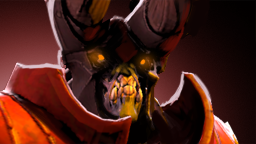
Doom
Doom Dota 2 is a melee strength offlaner built around one spell: Doom removes an enemy hero for 12/14/16 seconds — no casting, no healing — on a 140/130/120-second cooldown. Everything else serves it: Scorched Earth for trading, Devour for gold and a stolen spell, Infernal Blade and Lvl? Pain for chip damage. But the real gap closer into 400 range is Blink Dagger, not the kit. He wins 53.53% of 1,332 pro games and is banned 30.17% of league games; public ranked sits at 48.10% — the gap is whether teammates know who to Doom. Play offlane, get Blink by 19.0 minutes, and only rush Radiance when the 16.5-minute timing is real.
An offlane initiator, not a carry. 84.08% of his pro games start in the offlane and win 54.55%; 14.26% start in the safe lane and win 49.47%. His strength is a single-target shutdown that also stops healing; his weakness is that he has to walk into 400 range to use it.
7.41f has no Doom changes; 7.41e is his last patch. Build Phase Boots, then Blink Dagger and Black King Bar, and take Radiance only when the 16.5-minute timing is actually available; it is a 29.79% route, not the default.
Blink in, Doom the hero whose spells decide the fight, then survive. He gets a median of 6 Dooms per pro game, so every cast is a decision: keep Scorched Earth running before you jump, and put your attacks on the hero your team is already hitting — Lvl? Pain's burst pays out on whoever you hit.
Is Doom still viable in Dota 2 7.41f?
Yes in pro games, no in public ranked, and the gap is the story. In the 7.41 window Doom won 53.53% of 1,332 pro games, was picked in 14.62% of 8,972 league games and banned in 30.17%. Public ranked has him at 48.10% over 233,829 games — 5.43 points lower. Pro games and ranked are different games, so don't ask which number is right — ask what pros do that ranked players don't.
The public curve is a U, and the bottom is the middle. In public ranked: Herald 48.42%, Guardian 46.84%, Crusader 46.96%, Archon 46.63%, Legend 47.73%, Ancient 49.27%, Divine 50.29%. His worst bracket is Archon and his best is Divine, a 3.66-point spread across all seven brackets. That is a skill check rather than a balance problem: the hero rewards a player who knows which enemy to remove, and punishes one who walks in and presses the ultimate.
He loses short games and wins long ones. In 27,203 public games with duration data he wins 43.39% of games ending around 15 minutes, 49.47% at 30, 54.80% at 40 and 58.05% at 50. That is only about 11.63% of his public games, so read it as a direction: he needs a blink, a Black King Bar and one cooldown cycle before he is worth the slot, and a game that ends at twenty minutes never gets there.
Pro teams treat him as a ban target rather than a first pick. He is picked in 14.62% of league games and banned in 30.17% — 2.06 times more often removed than chosen — while still reaching 44.79% of all drafts. That is the profile of a hero teams are content to leave in the pool when they have an answer for him, and unwilling to face when they do not.
Nothing changed for Doom in 7.41f. The patch has no Doom entry; the last change was 7.41e, which cut his attack range and rebalanced Infernal Blade's burn. On 7.41f itself there are just 189 pro games, and he won 49.74% of them — 3.79 points under his window rate, a coin flip rather than a verdict. Everything below describes the 7.41e hero.
Which position should Doom play?
Offlane, and the margin is not close. In 1,120 of 1,332 pro games Doom starts in the offlane — 84.08% — and wins 54.55%. The safe lane is 190 games at 49.47%, which is 14.26% of his games and 5.08 points worse. Mid barely shows up in the data — too few games to quote.
The safe lane pays him more and wins less, which is the whole argument. Safe-lane Doom averages 688 GPM and 355.1 last hits against 600 and 260.9 in the offlane, so the extra farm is real — and the win rate still drops. He is not a hero who converts gold into damage. He converts a blink timing into one dead hero.
The jungle is not a plan, because Devour is not a farm engine. Devour has a 66-second cooldown and pays 35/70/105/140 bonus gold — one creep a minute — and pro Dooms use it about 24 times a game. What keeps him in a lane is Scorched Earth: 20/30/40/50 damage per second in a 666 radius, 6.66 health regeneration and 7/8/9/10% movement speed for 10/12/14/16 seconds on a 41/39/37/35-second cooldown. That is a trading tool, and it only pays if you are standing in a lane.
The offlane gives him the job the kit was built for. He is the hero who walks in and deletes one enemy from the fight; 81.76% of pro Dooms buy Blink Dagger at a 19.0-minute median and 76.65% buy Black King Bar at 24.1, which are the timings of a hero who fights for space instead of farming it. A safe-lane Doom gets more farm but wins less with it.
What actually changed in 7.41?
7.41 reworked his innate, and that is the change that matters. Lvl? Pain curses every enemy hero Doom attacks: 2.5 seconds later the curse bursts for 10% of all the damage Doom dealt that hero in the window, hitting the hero and everything in a 66 radius. If the cursed hero's level is a multiple of 6 — 6, 12, 18, 24 and 30 — the burst and its radius are 66% larger.
Devour got a stance and a shard. The default cast now takes the devoured creep's abilities and alt-cast keeps the ones he already has, the cooldown is 66, and Aghanim's Shard turns it into 2 charges on a 66-second restore that can also eat Ancients, with stolen spells getting 15% more area and 40% more spell amplification. A creep with no abilities leaves the ones you already have in place.
Four follow-up patches moved numbers, not mechanics. 7.41a cut his base armour by 1 and the curse from 15% to 10%; 7.41b took Scorched Earth's damage per second from 20/35/50/65 to 20/30/40/50 and Doom's from 25/45/66 to 22/44/66; 7.41c set Scorched Earth's regeneration to 6.66; 7.41d raised his intelligence growth from 1.9 to 2.1 and cut the shard's area bonus from 20% to 15%. None of it changes the build below: same max order, same item timings.
7.41e is the last change and it touched his reach and his sword. Attack range went from 200 to 175, Infernal Blade's base burn from 15/30/45/60 to 18/34/50/66 and its max-health burn from 1/2/3/4% to 0.5/1.75/3/4.25%. The early points of the ability lost percentage damage and the fourth point gained it, so the ability pays off later in the game than it did.
7.41f has no Doom changes, but it touched two items he buys.  Shiva's Guard's Arctic Blast went from 260 to 225 damage, and
 Octarine Core's total cost rose from 4,900 to 5,100; neither changes the timing below. In 7.41 Aghanim's Scepter gained Break and lost its +15 damage per second; it still spreads Doom to enemies near the doomed hero and can be self-cast. That is a rework of what the item is for rather than a number change.
What is Doom's skill build?
Max Scorched Earth, max Devour second, and leave Infernal Blade's points for last. His early skill points in pro games are almost all Scorched Earth and Devour: a third Scorched Earth point is the most common third choice (79.65%), Devour the most common fourth (59.76%), Scorched Earth is again the most common fifth choice (90.39%), and Doom is taken the moment it exists (93.77% at the sixth point).
Level one is close to a coin flip. 46.32% of pro games open with Scorched Earth, 39.04% with Infernal Blade, and the rest with Devour. Scorched Earth is the safer default — it is his trading and sustain tool — while Infernal Blade is the aggressive level-one pick, and it is the only one of the three that interrupts a channelled spell at level one.
Devour is maxed before Infernal Blade, and by a wide margin. Devour is the most common choice at the eighth, ninth and tenth points (78.68%, 84.19%, 74.17%), while Infernal Blade's points cluster at the twelfth, fourteenth and fifteenth (85.98%, 84.9%, 82.0%). The pattern fits: Devour is gold plus a free ability, while Infernal Blade's damage is a percentage of the target's health — a number that matters more once health pools are large.
Do not read this as a script. The most common ten-point sequence appears in 31.95% of the pro games that recorded ten points, so most games do something different with the last few slots. The stable information is the max order — Scorched Earth, then Devour, then Infernal Blade — and the fact that the ultimate is taken at 6, 12 and 18.
 123
 45
 6
 78910111213141516182025
What items should Doom buy?
A practical Doom Dota 2 build is Phase Boots (94.29% of pro games) into  Blink Dagger, with Radiance or Midas in front when the timing allows. The usual order:
 Phase Boots by 7.0 minutes (94.29% of games), Blink Dagger around 19.0 (81.76%),
 Black King Bar around 24.1 (76.65%) and Shiva's Guard around 31.4 (45.42%). Doom has no gap closer of his own and a 400 cast range, so the blink is not a luxury slot: it is the item that makes the hero exist.
Route one, Radiance: take it when the 16.5-minute timing is real. It is the first major item in 29.79% of the 1,289 pro games with an identifiable first purchase, landing at a 16.5-minute median with the  Sacred Relic at 14.9, and
 Radiance is bought in 33.93% of games overall. Those games win 61.46%, the best of the three routes — and that number belongs to teams that were already far enough ahead to afford it.
Route two, Hand of Midas: the even-game conversion.  Hand of Midas is the first major item in 29.33% of games at 11.3 minutes and those games win 50.26%, which is basically an even game. Read it honestly: Midas does not rescue a bad game, it turns a stable lane into levels, and Doom wants levels more than most heroes because the ultimate sits at 6, 12 and 18 and the level-20 talent cuts 10 seconds off its cooldown.
Route three, Black King Bar first: the fight-now route. It is the first major item in 26.38% of games at 23.8 with a 49.41% win rate, and it appears in 76.65% of all games as a purchase — the gap between those two numbers is the point. BKB is not a timing you race toward; it is the answer you buy when the enemy has the spells that stop you walking in, and it shows up in three games out of four eventually.
The cheap slots do more work than the expensive ones.  Aghanim's Shard is bought in 55.48% of games at 18.0 — more often than Radiance — and it gives Devour two charges, Ancient creeps, 15% more area and 40% more spell amplification on the stolen ability.
 Drum of Endurance is 46.17% at 11.3,
 Magic Wand 72.07% at 6.7,
 Bracer 69.22% at 2.3 and
 Wind Lace 67.57% at 7.5.
The luxury slots are reads, not a build.  Aghanim's Scepter is 25.15% at 37.8 and turns Doom into an area spell with Break; Octarine Core is 12.84% at 33.0 and Refresher Orb 5.93% at 48.9. Their recorded win rates are high — 61.19%, 76.02% and 62.03% — and every one of them belongs to a game that was already going well. Harpoon (12.39% at 26.7) is a second way in, and Assault Cuirass (9.91% at 33.6) is the armour version of the same idea.
Default build:Starting items  Tango
 Iron Branch
 Circlet
 Gauntlets of Strength→Lane: Bracer at 2.3 min, Wand, Wind Lace BracerMagic WandWind Lace→Phase Boots — 94.29% of pro games, 7.0 min median Phase Boots→Fork at 11–16.5 min: Radiance only when the 16.5-minute timing is real, Midas otherwise RadianceHand of Midas→Drum of Endurance — 46.17%, 11.3 min Drum of Endurance→Aghanim's Shard — 55.48%, 18.0 min: Devour charges and Ancients Aghanim's Shard→Blink Dagger — 81.76%, 19.0 min: the item that makes the hero Blink Dagger→Black King Bar — 76.65%, 24.1 min Black King Bar→Shiva's Guard — 45.42%, 31.4 min Shiva's Guard→Late luxury Aghanim's ScepterOctarine Core
 Refresher Orb
 Harpoon
 Assault Cuirass
Which talents should you take?
Level 10 is close to a coin flip, and pros lean magic resistance. 613 pro games take +10% magic resistance (50.41%) against 467 for +0.2 seconds of Infernal Blade stun (49.46%). Take the resistance when the damage that kills you is magical; take the stun when your team needs one more moment of hold to finish a kill.
Level 15 goes to Infernal Blade by a wide margin. 838 games take +1.5% max-health burn (55.37%) against 241 for +7% Scorched Earth movement speed (54.77%), and the two win rates are within a point of each other — so the choice is about what your game needs, not about which talent is stronger. The burn is the default because it is his only damage that scales with a big health pool.
Level 20 is the real choice: more damage or a shorter Doom. 606 games take +66 damage (62.54%) and 213 take 10 seconds off Doom's 140/130/120-second cooldown (61.97%). The damage is the default, but the cooldown talent changes how the hero is played: it is the difference between having Doom back for the next fight and holding it for the one after.
Level 25 is Mute by a wide margin, and the alternative is too small to judge. 305 games take Doom applies Mute (68.2%) against 51 for Permanent Scorched Earth (84.31%). That 84% is 51 games and should not be read as the better talent. Mute is the default because it closes the item slots as well as the spell slots, so a doomed hero cannot use a Ghost Scepter or a Eul's to survive the follow-up.
How do you counter Doom?
The counter is to make the one kill he sets up not happen. Doom's entire contribution is a single targeted removal: 400 cast range, a 0.5-second cast point and a 140/130/120-second cooldown, cast about 6 times in a pro game. A hero who fights from further away than 400 never gets cursed, and a hero who saves the doomed target takes the whole window away — which is why 81.76% of pro Dooms spend 2,250 gold on a Blink Dagger to close the distance themselves.
The bottom of the pro table is saves, bodies and elusive heroes. The eight lowest rows are Dazzle, Enigma, Treant Protector, Kez, Lone Druid, Clinkz, Earth Spirit and Bounty Hunter. Dazzle, Treant, Enigma and Lone Druid are the save-and-bodies group: Doom removes one hero, and their job is to keep that hero alive or to put another body in the way. Kez, Clinkz, Earth Spirit and Bounty Hunter are the other half — heroes who are hard to pin down for the 0.5 seconds the cast takes. Every row is only 20 to 65 games, so read the group, not the individual percentage.
The top of the table is carries who have to stand their ground. The eight best rows are Lifestealer, Weaver, Chaos Knight, Faceless Void, Ursa, Skywrath Mage, Terrorblade and Medusa. Four of them are melee cores who have to close the distance to do their job, and Terrorblade is ranged but still has to stand close to use his illusions, Medusa has no way out of a fight once it starts, and Weaver and Skywrath Mage are fragile enough that losing their spells is fatal. That is exactly the fight Scorched Earth's 666 radius and Doom's 12/14/16 seconds are built for. These rows are 20 to 71 games each: use them to see which drafts Doom is happy in, not as a duel result.
Items: one spell block, one push, and one clock. A  Linken's Sphere eats the targeted Doom, so he has to cast it on someone else — until he owns Aghanim's Scepter, bought by 25.15% of pro Dooms at a 37.8-minute median, which turns the spell into a self-cast aura around him that no single spell block answers. A
 Force Staff used on his target inside the 0.5-second cast breaks the cast outright, and after Doom lands the only thing on your side is the 140/130/120-second cooldown.
In the fight, spread out and know his clock. Aghanim's Scepter also Dooms the enemies standing next to the doomed hero, and Lvl? Pain bursts in a 66 radius around whoever he attacked, so two heroes standing together double that damage. His blink timing is the real start of his game: in pro games it lands at 19.0 minutes, and before that he can only walk at you.
At levels 6, 12, 18 and 24, do not trade hits with Doom. Lvl? Pain's burst is 66% bigger when the cursed hero's level is a multiple of 6, so a trade you were winning can turn into a death.
Lowest win rates against these heroes
 Dazzle38.46% · n=26
 Enigma40% · n=20
 Treant Protector40.35% · n=57
 Kez40.62% · n=64
 Lone Druid41.46% · n=41
 Clinkz41.46% · n=41
 Earth Spirit41.54% · n=65
 Bounty Hunter41.94% · n=31
Highest win rates against these heroes
 Lifestealer75.51% · n=49
 Weaver75% · n=24
 Chaos Knight70% · n=20
 Faceless Void67.74% · n=31
 Ursa66.67% · n=48
 Skywrath Mage65.85% · n=41
 Terrorblade64.79% · n=71
 Medusa64.71% · n=51
7.41-window pro matches from OpenDota Explorer, filtered so that the opponent is on the enemy team. Each number is Doom's win rate in those games, with the game count on its row; every row is only 20 to 71 games, so read the group rather than a single percentage. These figures include each opponent's overall strength and are a drafting reference, not the result of an isolated duel. Public ranked matchups are too thin to compare — the largest public row is 274 games.
How should you play the laning stage?
Open with Scorched Earth unless you are going for a level-one kill. It gives 20/30/40/50 damage per second in a 666 radius around you, 6.66 health regeneration and 7/8/9/10% movement speed for 10/12/14/16 seconds, for 60/70/80/90 mana on a 41/39/37/35-second cooldown. That is a lane-winning combination: you trade, you heal, and you can leave any trade that turns.
Devour on cooldown is your gold and your second ability. It pays 35/70/105/140 extra gold, eats a creep up to level 4/5/6/6 and hands you its ability for the rest of the game. In pro games the abilities most often taken are a Centaur Conqueror's stomp (322 games), a Black Dragon's fireball (295), a Satyr Soulstealer's mana burn (270), an Ancient Croaker's congregation (256) and a Satyr Trickster's purge (159) — a stun, a wave clear, a mana burn, a summon and a dispel. That is the shopping list for every walk to the camp.
Infernal Blade is your last-hit and trade tool, not your fight opener. It is 18/34/50/66 base burn plus 0.5/1.75/3/4.25% of the target's max health per second for 4 seconds, on a 13/10/7/4-second cooldown for 35 mana, and it interrupts channelling. Because the burn is a percentage, buying more health does not blunt it.
Lvl? Pain makes every attack a small bomb. Each attack on an enemy hero applies the curse, and 2.5 seconds later it bursts for 10% of the damage Doom dealt that hero in the window, in a 66 radius. The attack that starts the trade is already part of the payload, so hitting first and committing second is worth more than opening with a spell.
Do not leave the lane to farm. Devour is one creep per 66 seconds and Scorched Earth is a lane tool that also clears the small camp beside it. An offlane Doom in pro games averages 260.9 last hits and 600 GPM, which is not a farmer's stat line, and the safe-lane version with 355.1 last hits wins less. Stay where the fights are.
How should you play teamfights?
Blink, Doom, then stay alive — in that order. The cast has a 0.5-second cast point and 400 range, so the hero you want is the one whose spells decide the fight, not the one closest to you. If you Doom a tank while their save hero is still free, you have spent 140/130/120 seconds of cooldown on nothing.
Pro Dooms get about 6 Dooms off per game — most games sit between 5 and 8 — so each one is a decision. Scorched Earth is spammable at 35 casts and Devour at 24; Doom is not. Cast it before the fight starts when you can, on the hero whose silence or save would otherwise win them the fight.
Scorched Earth goes down before you jump, not after. It follows you for 10/12/14/16 seconds, so activating it on the way in means the aura is already ticking when you land, and the 6.66 regeneration is what keeps you alive through the return damage. The cooldown is only 41/39/37/35 seconds, so there is no reason to hold it.
Black King Bar is what makes the second cast possible. 76.65% of pro Dooms buy it at a 24.1-minute median. With a 0.5-second cast point and a 400 range, the enemy's stun arrives before your Doom does unless you are immune to it, so if you are the team's only way to start a fight, buy it before the damage item.
Aghanim's Scepter changes the shape of the spell, not its damage. It adds Break, spreads Doom to the enemies standing near the doomed hero and lets you self-cast it into a crowd, and it is bought in 25.15% of pro games at a 37.8-minute median. Against a lineup with two or three important passives, that Break is worth more than a fourth damage item.
What don't the ability descriptions tell you?

Which mistakes should you avoid?
Are any off-meta builds worth considering?
The tank version is a real route, but the win rates can't recommend it. Heart of Tarrasque (4.13% at 36.4), Assault Cuirass (9.91% at 33.6) and Octarine Core (12.84% at 33.0) all show win rates in the seventies, and all of them are bought by teams that were already winning. Read them as the shape of a comfortable game, not as a plan for a hard one.
The caster version is the scepter-and-refresher line. Aghanim's Scepter at 37.8 plus Refresher Orb at 48.9 (5.93%) give two Dooms and an area Doom, which is a genuine answer to a draft with two heroes you must silence. It is also the most expensive way to solve that problem, and it only exists if your team is already ahead.
There is no farming Doom. Devour pays one creep per 66 seconds and Scorched Earth is a lane tool, and pros put him in the offlane in 84.08% of games. No item route turns him into a jungler.
One caution: these lane numbers are pro-only. There is no public role data to settle a support build, and nothing in the kit is support-shaped. The kit is two spells that want levels and one that wants a blink, and none of that is support-shaped.
Five things to take into the game. One: play the offlane — 84.08% of his pro games do, and the safe lane wins 5.08 points less. Two: max Scorched Earth and Devour before Infernal Blade; take Doom at 6 and the talents at 10/15/20/25. Three: buy Phase Boots at about 7.0 minutes, Blink Dagger at 19.0 and Black King Bar at 24.1, and treat Radiance as the 29.79% route you take only when the 16.5-minute timing is real. Four: in a fight, blink onto the hero whose spells you need to erase — Doom lasts 12/14/16 seconds on a 140/130/120-second cooldown — and press Scorched Earth before you commit, because a 666-radius aura that follows you is free damage. Five: when the enemy has two or three passives you must switch off, buy Aghanim's Scepter — 25.15% of pro Dooms do, usually around 37.8 minutes. The rest is timing: runes, Tormentor and Roshan are on a clock, and the clock is DOTA Timer.