
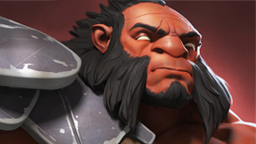
Axe
Axe is not a Culling Blade hero. The cull is 9.6% of the damage he deals; Blade Mail reflection is 31.3%, Battle Hunger 28.5%, Counter Helix 24.1%. He walks into your team, forces five heroes to attack him, and lets the arithmetic do the work: Call pierces spell immunity so BKB is not an answer, Helix is pure damage on a fixed attack count (misses included), and the cull is just how the fight ends. The build order shows it — 72.1% of Axe games finish Blade Mail before Blink Dagger, and the ones that rush Blink first win 43.9%.
Patch verdict: untouched for 79 days — 7.41f and 7.41a/b/c all did nothing to Axe; his last change was 7.41e. Across the last 23 patches he was changed in 13 and left alone in 10, so any "Axe has been nerfed repeatedly" claim is false on the record. 7.42 finally changed him: misses now count toward Counter Helix, Battle Hunger slows less, Culling Blade's team buff is a flat value, and the Call radius talent is smaller.
Bracket verdict: the curve runs downhill — 52.42% in Herald falling to 48.70% in Divine across 642,724 games that carry a bracket. He is a 50.65% hero overall who is good at the bottom and under 50% at the top, which is the exact opposite of Juggernaut.
Build verdict: Blade Mail first, and it is not close — 72.1% of games finish Blade Mail before Blink Dagger, and Axe players who take Blink first win 43.9% against 52.1%. The Scepter is bought by 7.8%; the Shard by 68.1%.
Is Axe still good in 7.41f?
Yes, with an asterisk that is bigger than it looks. The Axe Dota 2 win rate sits at 50.65% across 693,809 public games in OpenDota's rolling window, and dotacoach's 7.41f slice agrees at 50.5%. That is a hero who is exactly average — and average is a strange thing to be for the most iconic offlaner in the game.
He had not been touched in 79 days. He was not one of the 35 heroes changed in 7.41f, and neither 7.41a, 7.41b nor 7.41c touched him: his last change before 7.42 came in 7.41e. Across the last 23 patches he was modified in 13 and left completely alone in 10. 7.42 finally reached him — misses now count toward Counter Helix, Battle Hunger slows less, Culling Blade's team buff is a flat value, and the Call radius talent is smaller — so the win rates below are still the 7.41f snapshot.
The bracket curve is steep, and it points down. 52.42% in Herald, 48.70% in Divine — a 3.72-point slide that drops below 50% between Legend and Ancient. Axe is a hero who punishes players for standing in the wrong place, and better players do not stand there.
Axe has the steepest decline of the three. Necrophos loses 3.3 points climbing to Divine, Juggernaut gains 1.5, and Axe loses 3.72 and ends under 50%. The same kit that punishes a Herald lobby is a liability against a Divine one, because a Divine carry will not attack a blademailed Axe and will not stand in a creep wave with you.
What that means for you is simple. If you are below Legend, Axe's listed win rate is genuinely your win rate. If you are above it, you are playing a 49% hero and you need the draft to justify him — which is why the rest of this page is about when to pick him, not whether he is strong.
What position does Axe play?
Offlane, and essentially nothing else. 91.7% of his 123,242 tracked Axe Dota 2 games are offlane, at a 50.3% win rate. Position four and five together are 5.4%, and carry is 0.7% — numbers so small they are not roles, they are accidents.
He is the rare hero whose position is load-bearing rather than conventional. Axe needs to be in a lane where he can take damage on purpose, and the offlane is the only lane that offers that: two enemies who want to kill him, in a part of the map where his team does not need the farm he is not getting. Put him mid and he has no way to last-hit against a ranged hero; put him safe lane and he has nothing to do with the creeps he is given.
The lane-role data agrees almost exactly: 96.5%. OpenDota's ten-minute lane snapshot (1,088 parsed games) puts him in the offlane 96.5% of the time at 50.74%. That is the one number on this page where two independent sources, measuring different things, land on the same answer.
The non-offlane numbers are thin enough that you should not build a plan on them. 5.4% of the tracked sample is positions four and five combined, and the win-rate differences inside that sliver are within the noise of a few thousand games. What the table above does show is direction: three of the four non-offlane positions land under 50%, and the carry slot — 886 games, 45.9% — is the worst number on the page.
One thing Axe is genuinely good at, wherever he plays: he does not need gold to function. His damage is Helix (100/120/140/160 pure, based on being attacked), Battle Hunger (12/16/20/24 pure per second, no items involved), and Blade Mail (reflects what he takes). Only Blink and his survivability items are gold-gated — which is why a cheap, early build works on him and why 72.1% of the ladder buys Blade Mail first.
What's the Axe skill build?
*There is no right skill build on Axe, and that is the finding, not a dodge.* In 1,127 parsed 7.41 games the first skill point goes to Battle Hunger in 1,006 of them at 50.40%, and to Counter Helix in 117 at 49.57% — a 0.83-point difference, which is nothing. At the sixth point, 985 games take Culling Blade, at 50.36%. The ladder is not expressing a preference; it is doing whatever the lane demands.
There is a standard order, and it starts with Battle Hunger — 89.3% of games open with it, take Helix at the second point (84.6%), max Helix by the seventh (82.8%), then max Call (51.8% at the eighth, 56.9% at the ninth, 52.3% at the tenth), and finish Battle Hunger last. Culling Blade comes at the sixth point in 87.6% of games.
Do not read anything into the win-rate gap between the two first-point choices. 0.83 points across 1,006 and 117 games is a description of which lanes Axe was in, not of which skill is better. The same warning applies to the whole tree: this is a hero whose skill order is decided by the enemy heroes in front of him.
 1
 23
 45
 678910111213141516182025
What's the Axe Dota 2 item build?
Blade Mail before Blink Dagger, and the data is unusually one-sided. In 1,112 parsed games, 72.1% finish Blade Mail first and only 17.8% finish Blink first. The Blade Mail group wins 52.1%; the Blink group wins 43.9% — an 8.2-point gap that is a description of who wins, not a proof of why.
The reason is the hero's whole design. Blade Mail turns the damage he is taking into damage he is dealing while Call forces five heroes to attack him. 31.3% of the damage Axe deals in an average game is Blade Mail reflection — more than any single spell he casts. Without it, Call is just a taunt.
Blink is not optional, it is just later. The median Blink purchase is 15.3 minutes (13.7 to 17.0 in the middle half of games). Games that get it at 14–16 minutes win 57.0%; games that get it at 18–20 minutes win 30.6% — and that gap is still 37.2% to 59.4% when you compare only games of the same length.
The Shard is in about two-thirds of games and the Scepter is a specialist item. 68.1% buy the Shard (median 23.3 minutes) — it makes Call apply Battle Hunger and makes Battle Hunger stack. Only 7.8% buy the Scepter (median 31.2 minutes), which removes Helix's 0.3-second cooldown and gives it a stacking damage reduction debuff that now lasts 7 seconds (up from 6). A Scepter is not a required item on Axe: 1 game in 13 buys one.
Default build: Gauntlets
 Branches ×2
 Ring of Protection
 Tango→
 Boots→Core
 Blade Mail→Initiate
 Blink Dagger→Mid game
 Aghanim's Shard→3rd item
 BKB→4th item
 Shiva's Guard→Luxury
 Aghanim's Scepter
None of the numbers in this section are causal. Axe players who buy Blink first win 43.9%, but "first Blink" is also what a losing Axe buys when he is trying to find a fight he cannot win in lane. The 18-minute cliff is the same problem in reverse: an Axe who cannot afford Blink by 18 minutes is an Axe who already lost his lane.
It is a portrait of winning Axes, not a plan for becoming one. They finish Blade Mail first, they get Blink around its 15.3-minute median, and they take the Shard in the mid game. If your game does not look like that, the question is not "which item next" but "why is my timing late".
How do you lane as Axe?
Your lane is a bet that they will attack you. For Axe, laning turns incoming attacks into damage, and 56–60 damage, 3 armor, 670 health and 315 move speed is not a strong melee start — it is an average one. What makes Axe work is that being attacked is his resource: every attack against him — even one that misses — advances Counter Helix's counter, and Axe himself has +12 armor for the duration of Call when the trade starts.
Battle Hunger is the pressure. 12/16/20/24 pure damage per second for 12 seconds, cast from 600 to 900 range on a 20 to 5 second cooldown, and it slows by 16/19/22/25% — but only while the target is facing away from Axe. That facing rule is the detail most players miss: the slow only applies while the target is running away from Axe, so Battle Hunger is a chase tool, not an escape tool. It also ends the moment they last-hit or deny a creep, destroy a building, or get dispelled — which is exactly why you cast it on the hero who is not getting the last hits.
One Man Army is why Axe can stand alone. With no allied heroes within 700, he converts 50% of his armor into strength — free health, on a hero whose armor is high and whose items are armor. It decays over 3 seconds once a teammate arrives, so the ability rewards exactly the thing the offlane asks for: being alone in a lane and being hard to kill there.
What you are actually trying to do is make the creep wave expensive. Stand in it. Let them hit you. Hunger one of them, then the other. You are not trying to kill the carry at level three; you are trying to make him unable to stand in his own creeps without losing half his health.
What do you do in teamfights?
Blink in, Call, and then be hit. That is the entire plan and the only decisions are when to blink and who to call. Call's radius is 315 and it pierces spell immunity, so the answer to "their carry has BKB" is that you call him anyway — the taunt lands, and he spends his BKB duration attacking a hero with +12 armor and a Blade Mail up.
Culling Blade is a finisher, not a damage spell — 275/375/475 pure damage on a 175 range, on an 80/75/70 second cooldown. It is 9.6% of the damage Axe deals. What makes it valuable is what happens on a kill: every ally within 900 gains +25% move speed and +10/15/20 armor for 6 seconds, and Axe permanently gains 1/1.5/2 armor. The ability is a team buff that requires someone to be low enough.
Know the dispel list, because it decides fights. Culling Blade dispels Borrowed Time, Shallow Grave, False Promise and Battle Trance before it resolves, so none of those save the target. Aegis of the Immortal and Reincarnation are not prevented — those do save the target. Aeon Disk does not trigger against an instant kill at all, so it does not. And there has been no separate health threshold since 7.31 — the damage number is the threshold: it deals 275/375/475 pure damage and kills if that is lethal, which is why every old "cull line" table is out of date.
Blade Mail goes up before the damage. The order is Blink → Blade Mail → Call, because Call has a 0.3-second cast point and the Blade Mail has to be already running when the first spells land. Call is what keeps them attacking you inside the Blade Mail window. And against a physical-damage lineup, remember that Helix triggers on enemy attacks, even misses — taunting three right-clickers into you is how the damage actually gets dealt.
Who counters Axe?
Heroes who fight him at range, or who do not care about being called. Over the last 2,192 Axe Dota 2 games (10,960 matchup records, baseline 50.09%), his worst numbers are Centaur Warrunner at 41.4%, Ember Spirit at 41.4%, Necrophos at 42.6%, Spirit Breaker at 44.4% and Ringmaster at 44.5%.
The mechanisms are different and worth separating. Centaur is the mirror-match problem: a tank who wants to be called and who out-scales Axe's damage with raw HP. Ember Spirit and Ringmaster are the kiting problem: neither has to stand in the Call, and both can damage Axe from outside 315. Necrophos is the sustain problem — his aura does percentage damage that does not care about Axe's armor, and he out-heals what Axe can do to him.
The cleanest example is Centaur Warrunner at 41.4% on 162 records, and the hardest to play around: everything Axe does — Call, Blade Mail, Helix — is best against heroes who would rather not be hit, and Centaur would love to be hit. Lion has the biggest sample of the bad list (220 records, 45.5%).
Hardest matchups
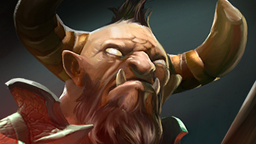 Centaur Warrunner41.4%
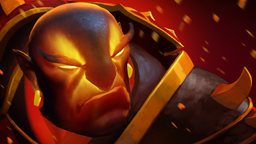 Ember Spirit41.4%
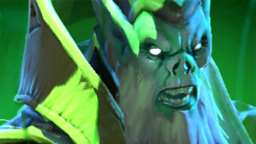 Necrophos42.6%
 Spirit Breaker44.4%
 Ringmaster44.5%
 Lion45.5%
Easiest matchups
 Techies59.6%
 Void Spirit59%
 Ursa58.4%
 Puck57.6%
 Skywrath Mage56.4%
Every hero listed here clears the 100-record threshold. Techies at 59.6% is his best matchup in the window — a hero with no answer to being called and no health bar to speak of. Ursa at 58.4% is the counter-intuitive one: the hero famous for winning man-fights loses the man-fight against Blade Mail plus a taunt. On the losing side, Centaur Warrunner at 41.4% is the number to draft around.
41.4% — the mirror problem. He wants exactly what Axe wants: to be called, to be hit, and to out-last whoever is hitting him. He out-lasts better.
41.4% — cannot be called and cannot be caught. Sleight of Fist lets him damage you from outside 315 and choose when to enter, so the Call window is his to give, not yours.
42.6% — his Heartstopper is percentage damage that ignores your armor and your Blade Mail, and his healing out-paces Battle Hunger.
44.4% — he charges in from outside vision and starts the fight on his terms. Axe wants to choose when he goes in; Spirit Breaker takes that away, and his bash interrupts whatever you were going to do after Call.
44.5% — a support who never has to enter 315 and whose kit redirects the fight away from where you are standing.
45.5% — two instant disables that land before Call does, on a hero whose entire plan is "blink in and press one button".
59.6% — good for you: no health, no escape, and a hero who has to stand still to place anything. Called Techies is a dead Techies.
58.4% — the man-fight champion loses the man-fight. Fury Swipes wants hits; Blade Mail returns them; Call makes sure he keeps hitting.
Who does Axe counter?
Anything that has to commit its body to do damage. Techies (59.6%), Void Spirit (59.0%), Ursa (58.4%), Puck (57.6%), Skywrath Mage (56.4%).
The pattern is not "Axe beats melee". It is that Axe beats heroes whose damage requires them to stay inside 315 long enough to finish a cast — and that includes Ursa, the strongest man-fighter in the game, because Blade Mail turns his strength into his problem. What he does not beat is anything that can do its job from further away than that.
What does the tooltip not tell you?
Any off-meta ideas?
No — this is about as position-locked as a hero gets. 91.7% offlane in the role data and 96.5% offlane in the lane data. Positions four and five together are 5.4% and both are under 50%. There is no hidden Pudge-style second life for this hero.
The one idea with real support is the "blademail-first" build, and on the ladder it is already mainstream. 72.1% of games already do it. The 17.8% who go Blink first win 43.9% — the data does not say Blink-first loses games, but it does say the players doing it are losing.
Which mistakes should you avoid?
Three things: Blade Mail first, Blink before 16 minutes, Call into the middle of them and let the arithmetic run. The cull is just how the fight ends, and timing is the rest of it — DOTA timer calls Bounty Rune, Wisdom Rune, Lotus, Tormentor and Roshan on time, with voice reminders. All you do is play.